Monday, May 6, 2013

A Case For Blogs Such as These

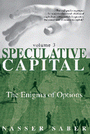
I am busy with the final volume of Speculative Capital. The book has been a long time coming; I lost track of the number of times entire chapters were rewritten because Nasser was not happy with them. But he is in the in home stretch now and an end-of-year publication date is a possibility. I think when you read it you will agree that it is different from anything that has come before.

The book has a chapter on theory of knowledge which made me think. How do we know what we know? I am not concerned with the epistemological/philosophical issues. I will leave them to Nasser to explain. My interest is in the more mundane aspects of knowledge. How do I know, for example, that the President of Ireland is precipitously close to violating his constitutional authority?

Why, I read it in the Financial Times. Here is the May 3 story under the heading Dublin defends president over call for ‘radical reform’
The Irish government has defended critical comments made by the country’s ceremonial president about EU leaders’ response to the economic crisis after questions were raised about whether he may have overstepped the mandate of his office.

President Michael D. Higgins called for a “radical rethink” of how the EU leaders tackled the crisis ...

Davie Gwynn Morgan, a constitutional lawyer ... told Irish radio the president may have exceeded the limits allowed under the Irish constitution. “It seems to be we are in unprecedented waters,” he said. “People feel that we are in a time of great stress and they should speak out even though it may be inappropriate for their office. It doesn’t seem to me like a good thing to do.”
The president of Ireland did not plan a coup. He did not interfere with the official function of the prime minister. Nor did he negotiate secret trade agreements. He merely criticized the EU for imposing austerity. The FT reported that as the Irish government being on the defensive about the president's insolent comments.

Note that the story is generated by one, single, solitary, half-literate pissant who says 'unprecedented' when he means 'unchartered'. Even he is not sure. He says it seems and may be what the president said was 'inappropriate'.

No matter. A scandal is whipped up and the Irish government is forced to formally defend the president. The point is to keep him on his toes; next time he will be more careful when he has an urge to criticize austerity.

That is why blogs like Dialectics of Finance are necessary. They act as an antidote to lies. Without them, the good guys are at a disadvantage.

Sunday, March 10, 2013

An Update

Nasser is in the 4th rewrite of the draft of Vol. 4. Each time, he expands its scope. I think he’s finally got it, as not much is left which is not already included! But I am not talking about a mishmash of stuff thrown together like a heap of disorderly bones. It is precisely the book’s synthetic thread, its binding and “totalizing” driver, which sets it apart from the others. It will be quite a treat.

In 1999, Nasser wrote in Vol. 1:
Theory is to explain what is happening, i.e., what is changing. The theory can explain the change only if it can show the cause and direction of the change and the point to which it must lead. In that regard, theory delivers us from submissive acceptance of events just because they occur and allows us to interpret them within the body of a logically constructed system and, if need be, take action to influence them.
Has the theory of speculative capital lived to that expectation? Let us look at a few disparate cases.

(1)
Nasser in the same volume:
Speculative capital is not bound to any one market or place. Rather, it is constantly on the lookout for profitable opportunities wherever it can find them. Upon finding such opportunities, it enters into these markets and, through arbitrage, “links” them together ... The linkage knows no limits in terms of markets. It can target two similar or approximately similar markets in the same country, two separate markets within the same country, two similar markets in two different countries or different markets in different countries.

The most elementary form of arbitrage linkage of two similar markets within a country is the one we visited earlier: the price of a stock (such as IBM) being different in the New York and the Pacific Stock Exchanges. ..The linkage of equities, fixed income and currency markets is less simple [and comes later].
From the Financial Times of Feb 20, 2013, under the heading, In search of fast bucks:
The prospect of the speed traders expanding their presence across global markets, linking numerous asset classes ever tighter, poses new challenges to traditional investors, companies – and regulators...

High-frequency trading in assets such as futures and fixed income has picked up in the past four years just as its presence in the US equities has waned. The gains are most visible in foreign exchange, where the global market share of high-frequency trading has soared to 40 per cent up from just a quarter in three years.
The presence of high-frequency trading in the equities market is “waned” because that market is arbitraged away. Speculative capital, Nasser pointed out, is self-destructive. It eliminates opportunities that give rise to it.

(2)

Nasser on his blog on January 22, 2012 about the goings on in Hungary under Viktor Orban:
If you are not Hungarian and ordinarily do not follow the affairs of the country, I say keep Viktor Orban’s name in the back of your mind. My guess is that you will see it again – and never in a positive light. In fact, that is how you will only hear of his name – until you hear of it no more.
From the Financial Times, this past Tuesday, under the heading Hungary accused of power grab
Hungary’s government is being accused of renewed attempts to monopolise power as it tries to reinstate measure from its new constitution last year that European authorities and its own top court had earlier forced it to drop.

In what critics say is a significant reversal, Hungary’s parliament is expected today to pass amendment that will restore many of the most contentious elements of the new basic law. “This [document] is a toxic waste dump of bad constitutional ideas,” said … an expert on Hungarian constitution at Princeton University.
So a country’s parliament passing a bill is considered a ‘power grab’ by the Financial Times and the Princeton critic whose language is decidedly neocon. The same paper reported the next day:
Mr Orabn has found blaming foreign banks and EU “interference” resonate politically. “In some elements it’s just popular [with voters],” says [the] director of ... a Budapest think-tank.
(3)

Nasser on “jobless recovery” on October 8, 2009
In the phrase “jobless recovery”, the news pertaining to the people is grim; there are no jobs to be had. Yet it contains “recovery”. So, what is it that is being recovered? The answer is: the agreeable rate of return of capital. The “data” measures the pulse and performance of capital, which the university professors study and comment about without ever understanding the larger issue surrounding it.
From the New York Times, this past Monday, under the title Recovery in U.S. Lifting Profits, Not Adding Jobs
With the Dow Jones industrial average flirting with a record high, the split between American workers and the companies that employ them is widening...That gulf helps explain why stock markets are thriving even as the economy is barely growing and unemployment remains stubbornly high....“There hasn’t been a period in the last 50 years where these trends have been so pronounced,” [an economist] said.
(4)

Nasser on May 10, 2010, about how Europeans are prodded to forget about the ‘old Europe’ and get used to the new conditions:
How much money you are earning or will earn in the future does not depend on what you spend today. Yet, the president of the ECB links the two. Why? Because “fiscal soundness” he mentions is the code word for reducing labor costs by cutting their pay and pensions. That is what the fight is all about: to bring down the labor costs to at least temporarily boost the growth, i.e., increase the rate of return of capital, whose consistent decline in the past decade remains a matter of serious concern to the planners of the European Union.
A professor of history at Columbia University opining in the New York Times on March 1:
So, from today’s perspective, the 1950 and 1960s look like a golden age. Its achievement now looks in danger of being undone. For it is not written in stone that Europe will always be identified in the minds of its citizens with growth and democracy.
(5)

Nasser on democracy, Nov 20, 2011:
Democracy is the name of the form of the government created by capital.
Financial Times, Feb 26, 2013:
Mr Monti ... reforms won the approval of the markets – but not of the voters.
Approval of the market but not of the voters.

The voters will soon find out who is the boss in a democracy.

Have a good week!

Thursday, January 31, 2013

The Ground of Existence – 3: The Shift in the Ground

I had written something different for this third part of Ground of Existence. It was about the Supreme Court and the evolution of the thinking of its justices. It followed where Part II had ended.

Then, two things happened. Firstly, several friends commented that the ground of existence was too heavy a topic for a blog. “Being comes into mediation with itself through the negation of itself”. Please, they said!

That was Nasser’s fault, I said. Bad influence.

Then, as if in response to an unuttered prayer, came the banks’ foreclosure practices settlement with the OCC. There was something in the story that could make the point I had in mind, only less abstractly. So I decided to use it. It fits less tightly with the previous parts; there is always a trade-off when you make compromises of this sort. But it made sense to go with it. The story is critically important in its own right. It is something that the readers of this blog must know.

In case you did not know, recently the Comptroller of the Currency settled the case of mortgage foreclosure “wrongdoings” against 14 banks by fining them a total of $8.5 billion. The story was the main business news in all media outlets and received extensive commentary. Let me quote some of what was said. I have underlined the cause of the OCC’s action.

The Financial Times reported the news of the impeding settlement on January 7:
The largest US banks are close to a $10bn settlement with regulators to resolve claims that they broke rules when seizing the homes of customers who defaulted on their mortgage
The “iconoclast” Huffington Post said this:
Under the deal ... the mortgage companies will make $3.3 billion in direct payments to “eligible borrowers” whose foreclosures were handled improperly, and will make $5.2 billion available in other assistance to struggling borrowers, such as loan modifications.
Lost Angeles Times had the story on its front page:
Ten of the nation’s largest mortgage servicers have agreed to an $8.5-billion settlement with federal regulators to end a review of foreclosure abuses.

The settlement … involved some of the biggest names in the financial industry, including Bank of America Corp., Wells Fargo Co., JPMorgan Chase Co. and Citigroup Inc.
The Wall Street Journal called the settlement a “shakedown”, then published the following letter to show that it is man enough to take critical comments.
Having served 9,000 homeowners in distress in California and attempted resolutions with almost all of the 14 major servicers, we disagree with your criticisms of the Office of the Comptroller of the Currency (OCC) and the Federal Reserve regarding...

The 6.5% of affected borrowers that you contend suffered financial harm is an erroneous figure by bank consultants who were paid $1.5 billion by the banking industry. Our estimate is more than 50% that suffered some type of harm.
The Newspaper of the Record wrote the following:
Federal banking regulators are trumpeting an $8.5 billion settlement this week with 10 banks as quick justice for aggrieved homeowners, but the deal is actually a way to quietly paper over a deeply flawed review of foreclosed loans across America, according to current and former regulators and consultants ... As a result, many victims of foreclosure abuses like bungled loan modifications, deficient paperwork, excessive fees and wrongful evictions will most likely get less money.
The article got lots of comments. “James” from Long Island wrote:
Pardon my selfishness, but what do the folks who live within their means and pay their bills get out of all this? Just asking.
Here, “James” is implying that foreclosures hit the “irresponsible” borrowers only. A variation of this theme is the frequently voiced comment that “despite” all irregularities, not one person who paid his mortgage on time was evicted.

That last point is absolutely correct. But James and his fellow selfish nincompoops who pointed to that fact missed the point. The significance of the case arises from something altogether unrelated to responsible social conduct by boorish behavior by banks which caused “some kind of harm” to home owners. In fact, none of the hundreds of reporters and commentators who wrote about it got the source of its significance right – but that is because the ground of existence of law has shifted!

Recall that the trigger of the ongoing crisis that exploded into the open in 2008 was the fall in the value of “mortgage-packed” securities. Nasser dissected the problem in his blog, here, for example. But we do not need the details. Just keep in mind that “mortgage-packed securities” were created by pooling the mortgages. Now, attention:

Q: Who created the securities?

A: The Wall Street firms.

Q: But the Wall Street firms are not mortgage lenders. They do not lend to home buyers. So, where did they get the mortgages?

A: They bought them from the banks.

Q: Meaning that the banks sold their mortgages to Wall Street?

A: Correct.

Q: But if the banks had sold the mortgages, then they – the banksno longer owned the mortgages. Right?

A: Right, exactly.

Q: Then, how could the banks foreclose? The OCC settlement is with banks. No Wall Street firm was involved. How could the banks foreclose if they were no longer holding the mortgages, meaning that they were no longer the lender of the record?

Aha.

Here, we need a few things about the jurisprudence in the U.S.

In the U.S., if your financial claim against a party is $5000 or less, you go to a small claims court. (In some states, the amount is lower, but $5000 is the ceiling.)

The small claims courts exist in many countries under such names as the elders’ councils or justice councils. Their role is to mediate the minor claims that arise from the social and commercial interactions at the local level. That relieves the higher courts from having to deal with petty disputes and minor sums.

Small claims courts exist in their own judicial world. Their ruling does not become a precedent. And because of the personal nature of the disputes, both the plaintiff and the defendant are allowed to tell stories about their loss. So if you are suing your cat sitter because she let your cat run away, you can sobbingly describe how dear the cat was to you. That is what you see in “Judge Judy” and her small claims court.

When the money in dispute is more than $5000, you have to file the claim in the civil court. No exceptions.

In the civil court, the “Anglo-Saxon” jurisprudence reigns. The rules of evidence kick in.

No personal stories are allowed in the civil court. The focus is on the violation of the law only. Taking the example of the cat, you have to show which law was violated by the cat sitter’s negligence. If there is no statute and no case law applicable, the cat sitter walks free not matter how severe your emotional distress. The centrality of law is the point of Oliver Wendell Holmes’ famous utterance: “This is a court of law, young man, not a court of justice.”

Because the language of the law is the frame of reference in deciding the cases, the technical law is all that matters: which evidence is admissible; which evidence must be presented for establishing a claim, etc. Hence, the role of lawyers who are trained in the law’s technicality. A defendant could be guilty as a matter of fact, but if the evidence against him is inadmissible – because it was obtained through illegal search or by threat or torture – the court will set him free. That is the meaning of a case being dismissed “on a technicality”, an expression familiar to all Americans of a certain age through real life cases or the court-room dramas on TV and in Hollywood movies.

Returning to our main topic, imagine you are a bank. A while back, you lent $200,000 to a homebuyer on which he defaulted. Now, to foreclose so you could claim the house, you have gone to court. There, the absolute first thing you need to do is to establish the evidence of indebtedness; you have to show that the party you are suing owes you money.

But as a participant in the great wave of securitization you have sold the mortgage note, remember?

Now how are you going to establish your claim? You are in a court where stories are not allowed. “Your honor, this is the copy of an advice that shows we deposited $200,000 a few years back to the defendant’s account” will not work. The defendant can claim that he returned the money next day in small bills in a laundry bag. He will demand that you produce the evidence of indebtedness.

With the evidence of indebtedness gone – or lost, or destroyed of misplaced in the mortgage frenzy – the only way to satisfy that demand is to create the evidence. That is forgery. Knowingly testifying to the authenticity of a forged document is perjury. Both are serious offenses punishable by jail time. That is what the closely related but now expunged-from-the-record “robo signing” scandal was all about.

In “robo signing”, a neutered phrase meaning “robot signing”, letters signed by fictional bank staff were presented as the evidence of indebtedness of homeowners who were late in their payments. Those were then used to start the foreclosure and eviction proceedings. Google “robo signing” and read some of the articles. They should make sense now. See also how the central crime of the case is consistently concealed as a matter of good journalism.

Yet, no one served a day in jail. And the settlement with the OCC will see to it that no one will. That is the critical point of the settlement – it is not the fine which works out to a few thousand dollars per “injured” party, but rather, shutting the door to legal action. The offending banks can no longer be sued. The case is closed.

But let us not focus on the OCC. The agency could not and would not settle the case if the rot had already not set in.

The rot is a legal one. It changes the law from a shield protecting the people to a sword attacking them. The headlines of a New York headlines a few months ago about the tactics of collection agencies put that succinctly:


Here is the opening paragraph:
The letters are sent by the thousands to people across the country who have written bad checks, threatening them with jail if they do not pay up.

They bear the seal and signature of the local district attorney’s office. But there is a catch: the letters are from debt-collection companies, which the prosecutors allow to use their letterhead. In return, the companies try to collect not only the unpaid check, but also high fees from debtors … some of which goes back to the district attorneys’ offices.
In the mortgage scandal, a few home owners did try to fight in court. They got nowhere. The fix – long in the making – was in. From the New York Times of November 29, 2010, reporting about the “high speed” court in Florida which was set up to handle the foreclosure cases:
Lawyers such as Mr Parker allege that these courts show leniency towards the sloppy bookkeeping of the banks, but crack down on homeowners who are ill-prepared.

In a testimony ... one executive from Countrywide Financial said it was routine not to pass along the original notes and related documents as part of the securitization process of the loans…

“After this, the judges in foreclosure cases are going to have to start ignoring massive systemic violations of law in order to grant foreclosures … Do we save the financial markets and sacrifice the rule of law? You can’t save both, you’ve got the sacrifice one for the other.
This “transformation” of the law is the shift in the ground of existence.

Tuesday, January 22, 2013

A Close up of a Few VIPs

“VIP” is an American appellation. It stands for very important person – or people; I am not sure which. Very important people do not wait in line. They get the best tables at restaurants. And often, they get to set or influence policy – if not directly, then indirectly. A few of them were recently in news.

(i)

Not Understanding What I Hear, Not Knowing What I Write

The recently released minutes of the Federal Reserve Board shows that as late as August 2007, the Board members had no inkling about the approaching storm. The Financial Times reported the story under the heading Fed red-faced as notes reveal officials failed to grasp dangers of 2007 crisis.

The ever obsequious New York Times put a positive spin on the story and presented it as the problem of scarcity of data. We learned that one Board member had presented as evidence of weakening economic conditions his private conversation with a Wal-Mart executive who said that Mexican workers were sending less money back home. Blah, blah, blah.

Of course, no institution in the world has more facts and data about the U.S. economy than the Fed. So what blinded the Board Members was not the paucity of facts, but the inability to interpret them. The mind is an active, synthesizing and interpretive faculty. A deficiency in its interpretive dimension makes it less than whole. The interpretative deficiency we are discussing has its roots not so much in biological, but social factors: facts must be fitted into the Procrustean Bed of the official beliefs and ideologies. As these beliefs and ideologies are false, the interpretations they lead to are necessarily bunk.

Two years before the 2007 Federal Reserve Board meeting, and with the knowledge gleaned from the reading only the newspapers, this is what Nasser wrote in Vol. 3 of Speculative Capital:
The rise of credit derivatives is the latest evolution of finance capital where market and credit “dimensions” are brought together. We are currently witnessing the early stages of this development. But armed with the theory of speculative capital we can see what is happening, i.e., what is changing. We can also discern the cause, pattern and characteristics of the change. So whereas for others credit derivatives are the risk-diversifying, need-fulfilling products of an innovative Wall Street, for us they are the footprint of speculative capital on its march towards systemic crisis.
(ii)

Ditto

Speaking of inability to interpret, a couple of times in his blog Nasser mildly criticized Mohamad El-Erian’s understanding of finance. El-Erian, in case you do not know, is the CEO and co-chief investment officer (with Bill Gross) of Pimco, the largest fixed income fund in the world, with $1 trillion under management.

Both Gross and El-Erian are media darlings. Rarely a day goes by without one or both of them appearing on a TV program or penning a commentary piece in the Financial Times.

Yet, what is the quality of their comments? Here is what El-Erian, rumored to be the more intellectual of the two, wrote on January 8 in the FT:

The investment recommendations made by many financial commentators are dominated by cross-asset-class relative valuation rather than the fundamentals of the investment. A typical refrain runs something like this: buy X because it is cheaper than other things out there.

This is an understandable approach, as unusual central bank activism has artificially elevated certain asset prices. Yet the dominance of this increasingly popular advice comes with potential risks that need to be well understood and well managed.

In talking about the “domination” of “cross-asset-class relative valuation”, our man is describing the modus operandi of speculative capital. Nasser developed a theory and wrote a series of books on that. From his Vol. 1 (1999):
Speculative capital is massive in size. It grazes on the spreads and brings volatility to markets … Because speculative capital was hidden from the view, the cause of this volatility remained a mystery. Markets seemed increasingly irrational.
What can you really know about a stock when its value seesaws 10% or 15% in the space of a week or less for no apparent reason? Not much, say some perplexed investors. With the stock market embroiled in some of the most volatile moves in years, it is getting increasingly difficult for money managers to plan and execute their strategies. (Wall Street Journal, November 24, 1997, p. C1)
And:
Rising volatility is worrisome, if only because people who are paid to study such things have no clear answers as to why it is happening now. (New York Times, August 31, 1997, p. F4)
Nevertheless, fund managers must deliver results. Staying on the sidelines on account of volatility is not an option. What can they do if stocks are volatile and drop for no apparent reason? The answer is that they discover “relative value” trading. A news story in the Wall Street Journal captured this crucial shift in stock trading strategy:
[Mr. Schermerhorn who manages $4 billion] also scorns the growing emphasis on “relative” valuation, comparing a company’s P/E ratio with those of other companies in the sector, rather than absolute valuations or historical levels. But other investors concede they are reluctantly having to pay more attention to relative valuation. “Lately, if you’d used almost any kind of absolute-valuation guidelines, you’d have kept out of this market altogether, and missed a lot of the bull market,” sighs Mr. Jandrain [who manages a stock fund]. “The reality is that we’re still at record [valuation] levels historically by nearly every measure, and you have to look for pockets of relative value.” (Wall Street Journal, November 24, 1997, p. C1)
“Rrelative value” trading – comparing one stock against similar stocks – is arbitrage trading. Mr. Jandrain … is being forced to disregard forecasting, i.e., individual stock analysis with an eye to estimating its future growth, in favor of buying relatively undervalued or selling relatively overvalued stocks. He calls that “looking for pockets of relative value.” But arbitrage by any name is arbitrage. In his quest for pockets of relative value in the equities market, Jandrain has assigned his fund to the ranks of speculative capital, thus guaranteeing that relative value trading, and, with it, the volatility of the stock market, will increase.

Such is the impact of speculative capital on financial markets: fund managers reluctantly joining a trend which they abhor and whose dynamics they do not understand. In the process, they push stock market even higher. Those traders who position themselves to profit from a decrease in P/E ratios get clobbered.
Relative value trading, rise in the market volatility, rise in high-frequency trading, synchronization of the markets across countries, correlation of assets classes (bonds, stock, commodities) as a result of which they all move up and down at the same time (and render diversification for the purpose of hedging pointless) and finally, globalization have but one common cause: speculative capital. El-Erian sees every one of those causes and can dispense expert advice about the best trading strategies under each condition. What he cannot do is see the larger force that links them all together. That is why he could never see what is about to come not matter how hard he looks – or thinks.

(iii)

The Chief of the Naval Operations of Afghanistan

What would you say, and how would you react, if the man sitting next to you on a plane introduced himself as the chief of naval operations of Afghanistan?

Why, you would laugh. You might not actually say anything in consideration of etiquette, but you would involuntarily chortle. Afghanistan, after all, is a land locked country; I am not sure it even has a lake. So the idea of it having a chief of naval operations is prime facie absurd. How could the position even exist and what kind of an ass would accept it if he were offered?

Now, what would you say, and how would you react, if someone introduced himself as the Ireland pension ombudsman?

If you are not sure, see the above. The catch is that this position, unbelievably, does exist and is currently occupied by one Paul Kenny.

Why unbelievably? Because conceptually, an Ireland pension ombudsman is as absurd as an Afghanistan chief of naval operations. What makes the two comparable is that there is exactly the same number of protections for workers’ pensions in Ireland that there is access to open seas in Afghanistan.

From the Financial Times of January 3, under the heading Aer Lingus pension move sheds light on Ireland’s woes:
Under Irish law there is little oversight of the pensions sector and no safety net for workers. Solvent employers with underfunded schemes can wind them up and walk away.
Solvent employers with underfunded schemes – underfunded because they, the employers, have chosen not to put money into the fund – can wind them up and walk away. Just like that.

Note also the word “scheme”. There was a time pension plans were called plans. Now the FT, with its editors’ British sensitivity to words, calls them schemes. Here is the difference between plans and schemes:
“We know from what the Pensions Board has said that 80 per cent of defined benefit pensions schemes in Ireland are technically insolvent,” says Paul Kenny, Ireland pension ombudsman.... But the real issue, analysts say, is whether Irish politicians are prepared to force already hard-pressed businesses to top up the underfunded pensions.

Jim Kelly, regional secretary with the Unite trade union, said companies were using the economic crisis in Ireland as an excuse to close their defined benefit schemes and in some cases to try to get out of providing any pension to workers.

“In the current difficult economic climate businesses are putting more emphasis on their own viability than on their employees’ entitlements,” Mr Kelly said. “This will end up being a disaster for the future. It is only when we get out of this crisis that we will see the real tragedy that has occurred for workers.

(iv)

A Sad, Sad Woman

I am talking about Ruth Porat who is being considered for the No. 2 spot at the Treasury.

Ruth is quite a go-getter: Stanford, Wharton, what have you. A 2010 New York Times laudatory profile quoted he colleagues who said that she was “a tireless worker”. That turned out to be an understatement:
In 1992, during the birth of her first son, she was on the phone in the delivery room making client calls. And in her spare time she, along with her husband, a lawyer, renovate and sell New York City apartments.

Ms. Meeker, the godmother to each of Ms. Porat’s three sons, remembers one meeting with management at the media company Ziff Davis where Ms. Porat threw her back out. “Instead of leaving she laid on the boardroom table and continued on with the presentation,” Ms. Meeker said.
Ruth Porat reminds me of the Ugly – of The Good, The Bad, The Ugly fame – who, trying to entice his fellow thieves, asked them: If you work to live, then why kill yourself working?

The Ugly knew a thing or two about work-life balance.

Yet, there is another angle here beyond obsession with work and money that the Porats, renovating and selling fixed-it-uppers in their “spare time”, cannot hide.

Imagine – visualize – a woman lying in pain on her back on a table in a boardroom full of people and giving a PowerPoint presentation. Can you imagine a man doing it? A George Soros? A Tim Geithner?

Imagine making client calls when you are about to deliver a baby.

Can you top these scenes in obscenity?

There are different ways for the underdogs to put up a defense. Jean Genet gave us one in Our Lady of the Flowers: “If I declare that I am an old whore, no one can better that, I discourage insult.”

Ruth Porat is playing a variation of the same theme. She discourages criticism by being obscene herself. But the whole thing stinks: her behavior and the conditions that make her to behave the way she does. That she acts on her own “free will” only adds insult to the injury. There is an Exhibit A of “internalizing the external conditions” if there ever was one.

Monday, December 31, 2012

The Ground of Existence – 2: Elaboration

1.      Hegel arrives at the ground of existence in Part II of The Science of Logic under the Doctrine of Essence.

Hegel’s philosophy is an evolutionary, integrated whole, in which the order of appearance of categories corresponds to their logical place in the system. So saying that the ground of existence is a category under the Doctrine of Essence is more than a random citation from Logic’s table of contents. It is also a reference to the coordinates of the ground of existence in the Hegelian dialectic. We need that information to determine how best to go about explaining the category.

2.      The Logic – as the The Science of Logic is known to the students of Hegel – has three divisions:

I. Doctrine of Being
II. Doctrine of Essence
III. Doctrine of Notion

The Doctrine of Being is concerned with what a thing is.

The Doctrine of Essence is concerned with how it has come to be.

The Doctrine of Notion is concerned with why it has come to be.

If we know what a thing is, how it has come to be, and to what end it is designed (and capable of progressing), we would know everything there is to know about the thing.

3.      The main categories of the Doctrine of Being are quantity, quality and measure. Every being is defined by these three main attributes.

Quality and quantity are well known: they are the two, famously mutually-exclusive attributes of a thing.

The measure is the third leg of the triad in which the chasm between quality and quantity is overcome. Hegel shows that the opposition between quality and quantity – that one always excludes the other – is not absolute and that accumulation of quantitative changes in a being results in a qualitative change. If we heat water beyond 100 degrees Celsius, for example, its quality changes from water into steam. That point of quantum leap is what he calls measure.

4.      The being cannot explain itself. It just is, so we accept it as a fact. But how it came about to be is impossible to determine by studying it. A being must come from something more profound than itself. That something is the “opposite” of being in the sense that while the being is, and so it directly appeals to our senses, what explains it is not perceptible by senses and must be deduced logically. This process of logical deduction is called mediation.

“Being comes into mediation with itself through the negation of itself,” Hegel wrote. What he is saying is that being “negates” itself, meaning that the mind cannot accept it as the source of its own existence, so the mind is forced into contemplation – or mediation.

The mediation of the being – where it has come from – is the realm of the Doctrine of Essence.

5.      I know of no other western book that surprises and at times even startles like Logic. There are many great books and some true masterpieces which have shaped our lives. Reading them, we are humbled, enlightened and awed by the reach of the human mind.

Hegel alone startles. That is because his philosophy proceeds along overcoming and going beyond Understanding. Understanding is that crude stage of comprehension where the mind only sees the differences.

Beyond Understanding there is the more advanced stage of cognition called Reason where the differences perceived by Understanding are found to be illusory. As Hegel’s dialectic continually aims towards Reason, it constantly lays bare the shortcomings of Understanding. That surprises and startles us. We are surprised how “self evident truths” turn out to be partial and thus, false. You saw that with the idea of measure. Upon first reading it, the mind receives a jolt from the idea of a qualitative quantity, which is what the measure is.

Now, take appearance. How many times you have been told to ignore the appearance and focus on the essence of things, and that the appearance is illusory and the essence is the permanent and the one that counts.

Hegel laughs at the idea. Essence and appearance are the one and same thing, he tells us. “Essence must appear”, he writes tersely, meaning that it’s the essence that appears. The conduct is the man. This president could have done so and so but was prevented by circumstances and detractors, or that general was a great strategist and tactician but was beaten by some folks in bed sheets and flip flops because he was distracted by bimbos – these are all drivel. In both cases – in all cases – we have the essence of the men in full display in their conduct. The same is true of the phenomena.

It is the essence that appears. Of course! What else could appear? How could one not see this obvious point – or lose the sight of it?

6.      Essence and appearance are the categories of the Doctrine of Essence, where the categories come in pairs: form and content, cause and effect and identity and difference. By way of explaining the “coming in pairs”, note that in our thought we can separate the idea of quantify from that of quality; the thought of one does not involve the thought of the other. Not so with the categories of the Doctrine of Essence. We cannot think form without thinking content. Or think cause without thinking effect. Or positive without negative. The thought of these correlative categories involves one another; each one defines, and is simultaneously defined by, the other.

7.      Let us develop this point of dependence of one thing on another further through the categories of identity and difference.

Suppose you are asked to compare New York to Tokyo. Even if you have not been to either city you can probably write a page on the subject.

Now, compare a camel and a pencil.

Here, you can’t really say much except that a camel is a camel and a pencil is a pencil.

In doing so, you would be repeating the famous laws of the identity and contradiction in the classical logic which hold that A is A and A is never B.

These laws are not so much wrong but “silly,” according to Hegel. They express abstract conditions which have no significance. There is nothing in common between a pencil and a camel, so the act of comparison is absurd.

We can meaningfully compare two entities if they have similarities and differences. The differences shed light on similarities. Similarities shed light on the difference. That is why using an analogy from optics, Hegel called them the categories of reflection. Like an object and its image in a glass, they shed light on one another, which is also why they come in pairs. There is a being that supports and a being that is supported.

Returning to our example of the two cities, precisely because New York and Tokyo are both large cities that we can say Tokyo is safer than New York. And precisely because they are in two different countries that we can say taxi fare in New York is cheaper than in Tokyo. It would be absurd to compare taxi fare in New York with taxi fare in New York, which is what A = A is.

7A.(To establish his concept of “utility”, Paul Samuelson began by equating the U.S. navy and an apple. He was in earnest. Of course, what he really proved was that his “theory” was viable to the extent that there are similarities between an apple and the U.S. navy. No matter. He made a fortune as an economist, won the Nobel Prize and was hailed a “titan”. Read Nasser’s devastating indictment of this charlatan here and here . It is telling that even now many think that he was a philosopher. Truly, only in America.)

8.      New York and Tokyo are merely different. Tokyo is different from New York, but so are Taipei and Istanbul and Dakar. From the difference, Hegel develops the concept of opposite, where each entity has only one opposite on which it depends: day and night, hot and cold, positive and negative.

9.      The development proceeds along the following lines. Likeness, we saw, depends on unlikeness. Unlikeness, in a similar way, depends on likeness. Each of these two categories depends on the other. One could not exist without the other. That is the category of opposite. Positive and negative are opposites. They are defined by one another and could not exist independent of each other.

10.  At this point we arrive at the ground of existence which is identity in difference. In the same way that measure was the third leg of triad (with quantity and quality) and reconciled their differences in itself , the ground of existence is the third leg of the triad that begins with identity and difference and, in a like manner, reconciles and resolves their opposition in itself. Measure was quantitative quality. Ground of existence is identity in difference.

11.  Identity in difference might sound paradoxical and confusing to Understanding. But we are beyond that and in the realm of Reason! We know what it means. When we speak of essence and appearance, we are speaking of identity in difference. Essence and appearance are two different things. But they are the same. It is the essence that appears! If there were no appearance, there would be no essence. In a like manner, if there were no essence, nothing could appear. Essence and appearance, form and content and force and its manifestation all express the idea of identity in difference.

12.  When there is a ground of existence, there must be something that is grounded. If positive is the ground, then negative is grounded – and vice versa. The ground of existence of a thing is thus part of the thing itself. Otherwise, it would be external to it and thus, incidental and contingent.

13.  Understanding only sees the external relations which are incidental and contingent. So it sees the phenomenal world as a congeries of objects which stand independently by themselves and at times come into contact with one another, influencing and impacting one another. It is the partial and one-sided view of It’s Wonderful Life where the protagonist’s life “touches” many people’s lives.

14.  In such as world, there could be no law, no organization and no planning. Capra's movie admits that much. Witness that its central story is an accident of birth which determines whether a community will be sinful and corrupt or beautiful and peaceful.

That is another variation of the hero worship theme, the stuff of going back in time to kill Hitler to prevent WWII! It is vulgarity through and through with Hollywood its ground of existence.

15.  Returning to variety which pervades the world, note that its correlative category is constancy. Variable would have no significance if they were no constant.

Constancy and identity fully reveal themselves in the ground of existence, as follows.

16.  The phenomena are what they are by virtue of the working of their inner organizing principle. More concisely, they reflect their ground of existence, that permanent entity that preserves and manifests itself in the midst of infinite variety. Hegel uses the example of the Ego to illuminate this point. All the variety of a person’s actions and conduct under various circumstances find a common ground in the centrality of his “personality”, which remains unchanged.

17.  The ground of existence is the constant in the midst of variable. But it is constant up to a point. Like a man’s personality, it has the potential to change over time under the influence of an even greater force. That force is the subject of the final stage of the Logic in the Doctrine of Notion. There, Hegel shows that the Idea, the supreme logic of the world, is the true constant because in changing, it changes into itself.

Ground of existence, however, is sufficiently constant that its changes, while at times barely perceptible, are noteworthy events. Such are the changes currently taking place in the US

18.  The system of checks and balances is the leitmotif of democracies. Everyone is taught that the separation of the branches is the foundation of a democratic government and that the legislative and the judicial branches exist to ensure that executive branch could not usurp undue power, which is what happens in the “authoritarian regimes.” The mantra is repeated often enough that it become an article of faith to the citizenry, the most obvious of the self-evident truths.

19.  Hegel laughs at the idea! In the Doctrine of Notion, he deduces the three factors of notion as universal, particular and individual. These categories follow the ground of existence, so contain the idea of unity in difference – but they contain more. Each factor is distinct from the other two but at the same time contain them. I am a unique individual, while at the same time belonging to a particular group (male species, for example) and the wider universal human race. No individual can exists without belonging to a universal. In a like manner, no universal can exist without having produced an individual sample.

20.  The three branches of the US government, like the three factors of the Notion, are aspects of the one and the same whole which is the state. Each one of them stands separate from the other two, but at the same time individually contains them; each branch individually reflects and represents the state. If that were not the case – if they were independent, opposing entities – the state could not function. It would dissolve into dysfunction and chaos.

21.  The full proof that the ground of existence of the state is giving way is too long for this blog. Nor is it necessary; a few examples from the judiciary will suffice. I will return with them in the concluding part.


Saturday, November 3, 2012

The Ground of Existence – 1: Introduction

A few weeks ago I read a noteworthy article, noteworthy not because of what it said but because of how its author reacted to what he was describing.

He had been watching a ‘news analysis’ program where the guests were “discussing” the Iranian “nuclear bomb.” It was the usual obscene show of a pack of baying dogs delivering a pack of lies about the existential threat of Iran to this and that and the need for more sanctions and military options. Then one of the regulars, Patrick Buchanan, had pointed out that Iran had consistently denied developing nuclear weapons; the country’s supreme leader has declared more than once that building nuclear weapons is against Islam. Sixteen U.S. intelligence agencies concur: Iran is not developing nuclear weapons. The IAEA, too, which is closely monitoring Iranian nuclear facilities, found no evidence of nuclear weapon program. In short, there is no evidence that Iran is working on a nuclear weapon. Nothing. Nada. Zilch.

After Buchanan’s ‘input’, the author wrote, he was expecting a shift in the discussion or at least a change in the tone. After all, the premise of what was being said had been preempted. To his surprise, nothing happened. The guests totally ignored what they had heard and continued with their rants until the end. The writer was wondering what gives. What could explain such conduct?

Such “conduct” is more common than many think. In fact, it is de rigueur in high places these days. But precisely because it is so prevalent, people notice it only when it takes a particularly offensive in-your-face form.

This year’s Nobel Prize in economics, for example, went to two guys who are not economists and one of them is even aware of that fact. Lloyd Shipley, one of the two winners, told the Associated Press: “I consider myself a mathematician and the award is for economics. I never, never in my life took a course in economics.”

The new laureates’ area of research is “matching”: men and women (through speed dating), students to schools, and recipients to organs.

Why, you might ask, in the midst of a protracted economic/financial crisis in the West is the Nobel Prize in economics given to lighthearted folks investigating match making? Was there no research on the causes of the crisis and the way out of it?

The answer is that the official economics cannot explain the crisis, and those works that can, are outside the accepted theories, which the Nobel Committee cannot recognize. Hence, the only option left, which is looking the other way. That’s how it comes to pass that a glaring reality that has ravaged the lives of tens of millions is ignored.

Or take the Treasury secretary Tim Geithner. According to the Financial Times, he and Larry Fink, the head of BlackRock, spoke no less than 49 times in the past 6 months over the phone. How many times in person, no one knows.

Part of the conversation was no doubt job related. Geithner is leaving at the year end and he will need a multi-million dollar salary to support his family after the penurious Treasury years. It could also be that Larry Fink is auditioning for the Treasury job – or both. But the official story, that the secretary needs to be in touch with “market participants”, is also true, only you have to understand what that means.

In the same period, Geithner called Vikram Pandit, the recently ousted Citi CEO once and Bill Gross of Pimco zero times. Bill Gross is a trader and not particularly strong in matters of theory and abstract thinking; he recently likened the U.S. government’s borrowings money to an addict who “pleasures itself with budgetary crystal meth,” clearly not realizing that the analogy would make him a drug kingpin. Still, if you are the Treasury secretary and want to get the pulse of the market – which was ostensibly the reason for the calls – wouldn’t you want to talk to the manager of the largest debt fund in the country?

But that reasoning would be missing the point, which is that reasoning and logic have got nothing to do with it. Geithner does not want to learn about policy options and alternatives. He wants input and direction, and Larry Fink provides both because Larry and Co. are the ones who give guidance to the Treasury. Call them the “in” crowd. The likes of Gross and Pandit are outsiders. They could get rich and famous thanks to the Treasury policy but they will have no say in setting that policy which has facets beyond matters of money and finance. For that reason, it does not matter what they think. So they might as well be ignored, which they are.

Like gold, which Shakespeare said makes black, white, foul, fair and wrong, right, being “in” makes meek bold. Witness the meek Bernanke whom everyone hailed as bold after he announced his QE3 program. In this 3rd phase of the so-called quantitative easing, the Fed chairman is resolved to buy $40 billion worth of mortgages every month pretty much until his term is up in 2014. He says he is doing it to tackle joblessness. That no one can explain how buying mortgages creates jobs matters not. He just says so, the way James Baker, Bush Sr.’s Secretary of State, said that invading Iraq was about jobs.

Meanwhile the Chairman rejects the criticism that mortgage buying artificially lowers the dollar’s value against the rival currencies (because the dollars that pay for the mortgages he creates from the thin air). He said:
The Fed isn’t responsible for artificially boosting rival currencies — and that other nations should let market forces determine exchange rates anyway.
The man who interferes in the markets to the tune of half a trillion dollars a year advises others to let market forces determine exchange rates.

Finally, the Supreme Court and the way it has been upholding the law of the land of late. A single example should suffice. No, not the much maligned Citizens United but the seemingly progressive Boumediene.

In Boumediene v. Bush, the Court decided 5-4 that the Muslim prisoners held indefinitely in Guantanamo Bay military camp had the right to habeas corpus – essentially the right to have their cases heard in the US courts – and part of the Military Commission Act under which they were imprisoned and which denied them that right was unconstitutional.

Linda Greenhouse, who won a Pulitzer Prize “for her consistently illuminating coverage of the United States Supreme Court” takes it from there:
To a startling degree, the conservative judges on the D.C. Circuit have been openly at war with the Boumediene decision [of the Supreme Court]. Judge Brown referred in her opinion to the “airy suppositions” of the Supreme Court’s majority. Judge A. Raymond Randolph ... in a 2010 speech to the Heritage Foundation, pointedly analogized the justices in the Boumediene majority to Tom and Daisy Buchanan in “The Great Gatsby”: “careless people, who smashed things up” and who “let other people clean up the mess they made.” ... Judge Laurence H. Silberman, in a concurring opinion a year ago, described the Boumediene decision as “the Supreme Court’s defiant – if only theoretical – assertion of judicial supremacy.”

Only theoretical? I can’t remember such open and sustained rudeness toward the Supreme Court by a group of lower court judges ... [A] court that had so much institutional pride just a few years ago ought to care enough now not to let itself be dissed by lower court judges who, in the system as I understand it, owe the Supreme Court obedience rather than on- and off-the-bench sniping.
The Supreme Court judges are appointed for life. They are practically untouchable. They have no reason to fear anyone. Their say is the last word in law. So why do they tolerate being openly dismissed and ridiculed by the lower court judges? Where, you might ask, is the loudmouth Antonin [broccoli] Scalia to put the errant circuit court judges in their place and remind them that in dissing the Court, they wreck the institutional judiciary for which the U.S was once renowned?

That question, too, would be missing the point. It would be akin to an uninitiated outsider wondering why the person being whipped in an S&M session accepts the pain and humiliation without complaint.

Scalia and Roberts like the contempt of lower courts towards Boumediene because they share that contempt, so strongly in fact, that they are willing to let it destroy the authority of the Supreme Court.

As Nasser observed, at the age of speculative capital, speculative capital is not the only self-destructive entity around.

And that is the commonality among all these cases; do not misread them as people in the position of power doing what they please. That sort of masters’ liberty about which Thucydides perhaps said the last word – the strong do what they can and the weak suffer what they must – has existed from time immemorial. But the strong of our examples are not imposing their will on the weak – not directly, anyway. They are, rather, pushing against the boundaries of a system that sustains them. In doing so, they are destroying their ground of existence.

It is a fascinating concept, this ground of existence. I must tell you about it.

I will return shortly to do so.

Sunday, October 28, 2012

A Percipient Observer

You have surely heard the long words about the wonders of science this and wonders of technology that, and how they were supposed to improve the quality of life and leave more time for leisure, etc. etc.

Here is Nasser in Vol. of Speculative Capital, circa 1999:
Linear programming epitomized the “objective” science. It seemed to be the embodiment of Friedman’s assertion that “positive economics is in principle independent of any particular ethical position.” The solutions it offered were arrived at mathematically and were indisputable. There was only one best way of scheduling oil tankers between a given number of ports if the profits were to be maximized or costs minimized. Democrats and Republicans, capitalists and communists, oil producers and tanker owners, all had to agree on it.

But while mathematics is abstract, it is always applied in the context of given social conditions. And precisely because mathematics is abstract, upon application it assumes the characteristics of the context to which it is applied. If the context is the Battle of Britain, the mathematics of linear programming shows the best way of organizing fighter planes. If the context is the profitability of commercial airlines, it still shows the best arrangement, which is now establishing “hubs” and cutting service to low traffic destinations. Both solutions are mathematically correct. In the latter case, because the purpose behind the application of the method has changed–and that purpose is determine by social conditions–the solution leads to a different kind of consequences: medium-sized and small communities become further isolated. If the Nazis had learned of linear programming, they could have used it for improving the flow of traffic in the concentration camps.
Now, this from today’s New York Times, under the heading: A Part-Time Life, as Hours Shrink and Shift. Note the role of “sophisticated software”:
While there have always been part-time workers, especially at restaurants and retailers, employers today rely on them far more than before as they seek to cut costs and align staffing to customer traffic. This trend has frustrated millions of Americans who want to work full-time, reducing their pay and benefits.

“Over the past two decades, many major retailers went from a quotient of 70 to 80 percent full-time to at least 70 percent part-time across the industry,” said [a consultant].

Technology is speeding this transformation. In the past, part-timers might work the same schedule of four- or five-hour shifts every week. But workers’ schedules have become far less predictable and stable. Many retailers now use sophisticated software that tracks the flow of customers, allowing managers to assign just enough employees to handle the anticipated demand.

“Many employers now schedule shifts as short as two or three hours, while historically they may have scheduled eight-hour shifts,” said [the producer of a scheduling software].

Some employers even ask workers to come in at the last minute, and the workers risk losing their jobs or being assigned fewer hours in the future if they are unavailable.

The widening use of part-timers has been a bane to many workers, pushing many into poverty and forcing some onto food stamps and Medicaid. And with work schedules that change week to week, workers can find it hard to arrange child care, attend college or hold a second job, according to interviews with more than 40 part-time workers.
Enough said.

Tuesday, September 25, 2012

The Fate of Man

Nasser’s forthcoming book is about the common destiny of men currently being shaped by speculative capital.

Much has been said about how globalization eliminates the local differences and turns the areas it touches into a bland sameness. Walk into any upscale mall in Taipei, Istanbul, Los Angeles or Dubai, and you will not be able to tell one city from another, not with the “location-neutral” Gucci, Hermes, Cartier and Prada stores surrounding you. Walk to Downtown and it is dotted with the familiar junk food outlets and Gaps and Starbuckses, 7-11’s and now, the Apple stores.

But it is not only the retail business that has been made standard. The symphony orchestras also sound the same, as I discussed in No Country. More pernicious, though, is the sameness of politics, as in setting policies. That, too, has been pushed into the single, there-is-no-alternative track dictated by speculative capital.

In the U.S., the shift began with Regan and gained speed under Bill Clinton; credit Sleek Willy with divorcing policies from the politicians. Since then, presidential elections in the U.S. have been reduced to choosing the ‘lesser evil’. The idea seems sensible; only Lucifer would vote for the greater evil. The trick is that the semi-illiterate electorate is programmed to see evil in terms of surface issues: abortion, gay marriage, gun control, “family values” – the usual election hot buttons. No one ponders why evil, no matter what its degree, should be prerequisite for the presidency. That evil is the policy direction about which the rabble has no say and on which both parties are in full agreement. No matter who wins, the ship of state maintains its per-arranged course.

Post-War Europe prior to Tony Blair and the EU was different. The political parties offered alternative visions of government and, once in power, put them into action. Even with the military dictatorships in Spain, Portugal and Greece, one knew where he stood.

Globalization changed that. The rule of finance capital which operates under the nom de guerre globalization does not permit any deviation from the path most profitable to it. It punishes dissent with the pincer strategy of financing the competition and choking off the funding sources. Incessantly pressured by that force, out went the goals, principles, ideas and platforms of the political parties in Europe. Sure, they could still differentiate themselves on local matters – we will encourage women’s participation in workforce – and their candidates could talk to their hearts’ content – remember Hollande describing finance capital as “faceless enemy”? – but upon assuming power they had to govern as per finance capital’s diktat. Absolutely and all times. Observe:

Portugal: Social Democrat Passos Coelho replaced Socialist Socrates. The result?
The prime minister, announced a 7 per cent increase in the social security contributions to be deducted from workers’ pay next year while employers’ contributions are to be cut by a similar amount ... Mr Passos Coelho said unemployment, currently above 15 per cent, could reach 17 per cent next year if the social security changes were nor implemented. (FT, September 17, 2012)
Spain: Center-right Rajoy replaced Socialist Zapatero. The result?
Mariano Rajoy, the new prime minister, warned this week that the economic outlook “could not be more somber”, and laid out another round of deep spending cuts on top of existing austerity measures. (FT, December 21, 2011)
Greece: Center-right Samars replaced Socialist Papandreou. The result?
On July 6, Mr. Samaras laid out the coalition’s plans, a bold program of selling government assets and reducing state spending. (NYT, July 10, 2012)
Notice the word bold.

France: Socialist Hollande replaced center right Sarkozy. The result?
The French prime minister has appealed for a “massive vote” in favor of the EU’s new fiscal discipline pact by his ruling Socialist party despite criticism that President François Hollande failed to deliver on his election promise to renegotiate the accord. (FT, September 20, 2012)
Hollande had campaigned on opposing the EU mandated austerity measures, so much so that after he was elected, some (fools) saw his presidency as the harbinger of a weakened EU. Daily Telegrph wrote:  François Hollande victory sets EU on course for turmoil. Fat chance.

UK: Conservative Cameron (in coalition with the Liberal Democrats) replaced Unprincipled Blair. The result?
George Osborne, chancellor of the exchequer, will map out spending cuts and tax rises that analysts believe could amount to £85bn ($126bn, €102bn). Treasury officials say it will be the most brutal budget for almost 30 years. (FT, June 22, 2010)
You get the idea. Democrat, Social Democrat, Liberal, Labour, Conservative, right, left, center-right or center left – they all act in the same way. They must, else they will not be allowed to assume power.

With the main policy direction prefixed and untouchable, governing is no longer about the public service, the term properly understood. It’s reduced to the petty stuff, of the kind that has always been practiced at the local level but was not the main thing in conducting national policy: influencing laws to benefit benefactors, installing the backers as judges and administrators, putting relatives on the government payroll, and, of course, securing one’s own future by being in good terms with the powers that be, as in here and here.

And yet – and this is the central point of this post – none of this should be taken to mean that anything is preordained. Or that the die is cast. Or the conclusion is foregone.

Yesterday, a strong public reaction in Portugal forced a volte-face on the part of the prime minister. He had to rescind the order reducing workers’ wages by 7% as part of his “fiscal devaluation”. He will instead increase taxes, which means that the populace has to pay through a different venue.

So the force that is speculative capital keeps doing what forces always do: exert pressure. But in the social realm, as in the realm of nature, any force can be counteracted, neutralized by even a greater force that lies dormant in society.

Saturday, September 1, 2012

The Ship of Fools [in control]: Diagnosis of a Social Unease

The unease of the citizenry about the “conditions” in the U.S. strongly comes through in every poll. The malaise is usually expressed in economic terms – lack of jobs, underwater mortgages, unaffordable insurance – but it transcends economics. It is a broader and deeper despair about what has gone before and what looms on the horizon. I wrote about the sentiment which Cormack McCarthy had touched upon in No Country for Old Men.

In the concluding part of the series we arrived at infantilism, a condition where grown men and women speak – because they think – like children.

Socially, being a child is defined by the absence of experience, more specifically, the absence of the opportunity to come into contact with the real world. So a toddler who has never seen a tiger will approach the beast without fear, as nothing in his mind associates a tiger with danger.

A developmentally retarded adult who has seen tigers before will also approach the beast without fear but only because he does not understand the danger. In this case, it is the inability to conceptualize and thus, comprehend the already experienced, that amounts to the absence of experience.

There is a difference between the two which language captures and coveys. One is innocence. The other, to use a very common word in the U.S., is stupidity. Innocent children; stupid adults: that’s how we frame our references.

All this by way of saying that when I say Nicholas Sambanis is a stupid man I am not hurling insults at him. All I am saying is that he is incapable of comprehending the world. See what he wrote this past Sunday in the New York Times about the EU crisis, beginning with an explanation of its causes:
There are many reasons behind the crisis, from corruption and collective irresponsibility in Greece to European institutional rigidities … But this is not just a story about profligate spending and rigid monetary policy… It is an escalating identity conflict – and ethnic conflict.
Greeks are corrupt. They are collectively irresponsible. Profligate spenders, too, especially when it is other people’s money, as we all know. Europeans institutions are rigid.

After this display of stupidity, he gets into the history:
The European Union was a political concept, designed to tame a bellicose Germany … Elites could sell that concept to their publics as long as Europe prospered and had high international status.
Vulgarity, thy name is Sambanis! Even reading this crap is embarrassing, an adult saying something like “international status of Europe”.

Nasser dissected the EU crisis in a 6-part series last year. Read it for an adult perspective. See how intelligently he defines Europe there.

Then note Sambani’s reference to the “elites”. It is telling. Who are the elites? What is he talking about?

Nasser explained that the EU was created in response to capital's falling rate of profit. To reverse the unacceptable fall, there had to be an EU through which labor costs would be reduced; that was the only way under the circumstances to raise the rate of profit. That the European people opposed the “initiative” – because however dimly, they understood it – mattered not a bit. In a democratic process, capital rules and overrules people, as we repeatedly saw.

Sambanis would not know that. But he has noticed that the idea of the EU came from high places; German butchers, Italian tailors and French bakers could not have conceived it, much less rammed it through the various governmental and legislatives labyrinths. So, who could have done it? The only answer he can imagine is “elites”. The “elites” did it.

We continue.
As Europe’s status declines, the already shaky European identity will weaken further … The result is a vicious circle: as ethnic identities return, ethnic differences become more pronounced, and all sides fall back on stereotypes and the stigmatization of the adversary through language or actions intended to dehumanize, thereby justifying hostile actions.
He is concerned that corrupt and irresponsible Greeks will stereotype bellicose Germans and vice versa and the ground will be set for hostilities.

Is there no hope, then? Happily, there is.
Germans must have a frank public discussion about what it means to be European, how good European citizens should behave toward other Europeans and why a strong Europe is good for German interests… Without such a discussion, and real concessions to Greece, a Greek exit is inevitable — and with it the triumph of parochialism in Europe.
Albert, Herbert, Heinz, Willy! Call up your friends and siblings and let's all sit down and talk about what it means to be good European citizens. Why? Because the fool across the Atlantic says so.

Alice in Wonderland characters would shake their heads in disbelief.

But the writer of this drivel is in earnest. He cannot not be earnest, being a “professor of political science and the director of Program in Ethics, Politics and Economics at Yale”. In that capacity, he trains the next generation of American leaders in the New Haven morgue.

His position also makes him a member of the establishment and the intellectual elite in the U.S. Together with the Rachmans, Friedmans and Krugmans, he influences and, at times shapes, the policies of the United States in Europe, the Middle East and South Pacific.

Imagine.

Of course, the drivel is not neutral. It is constructed in support of a certain worldview which supports certain conduct. But it is drivel nonetheless and must bend to the realities of the world.

The populace dimly recognizes that fact. The realization is dim, hence its vagueness. But it is realization nonetheless, hence the unease.

Tuesday, August 7, 2012

Epilogue: ‘No Country For Old Men’

“I can’t go on. I’ll go on” are the famous lines of Beckett’s absurdist characters who are at the end of their wit thanks to the relentless punishment they have taken.

The epitome of classical punishment in the West is the myth of Sisyphus, a king condemned by the gods to push a rock to the top of the mountain only to see it roll back, after which he had to start again.

That punishment is easy to understand. It was meted out through the exertion of intense labor without purpose and end. But labor somehow dignified the condemned. The story is a somber one and Sisyphus is no clown.

Modern Beckettian characters suffer a punishment of an altogether different kind. In terms of setting, they have complete freedom. They could come and go as they please. But they are idle, with whatever little movement there is being spontaneous and without purpose.

We do not know why they are in that situation. Nor do the characters themselves. Not that they seek answers or suspect that the situation demands an explanation. Apathy is all there is. (In Waiting for Godot, Vladimir and Estragon do not bother to hang themselves).

In the continual idleness, words fail. They lose their connection with the material world. They become absurd. The characters uttering absurdities become the subject of ridicule. They appear as fools, crazies, clowns and tramps.

That is the nature of the modern man’s punishment, being ‘free’, yet unable to act with purpose, acting with purpose being what separates him from the beast. (Beckett said that his Endgame was “more inhuman than Godot”.)

Even relating this situation is punishing, as Beckett no doubt knew. At the end, his style which had been evolving, hit a wall. Becket was describing situations that could not get worse; any further deterioration would dissolve their “plot” into nothingness. The language describing those situations likewise could not improve. Any “improvement” would sink it into incoherence. The critic Richard Seaver observed:
Is it possible for Mr.Beckett to progress further without succumbing to the complete incoherence of inarticulate sound, or to ... silence?"
Indeed Beckett produced little prose afterwards.

Replace the “situation” in Becket with “old age” and you will have the condition of old writers, composers, painters and directors in the West generally and the U.S. particularly. They can’t go on because they have nothing of value to say. “The talent has run out”. But they must go on because they need money. The result, when artistic works of no value must be commoditized and sold for money, is the absurdities, farce, drivel and incoherence that we see. But unlike Becket’s characters, the old artists in the West know, or at least feel, how much they have diminished, the way a senile ex-Olympian on a wheelchair would feel and know. Hence, the angst and the depression.

Life, you see, is dialectical. So is the evolution of thought which comprehends it. The driver of dialectics is progression from falsehood to truth: the mind perceives the worldly object, notices its contradiction (falsehood) and proceeds to resolve it at a higher plane of reason, higher in the sense that the previous contradiction is explained in the new phase and absorbed into it. The dialectical process is the process of evolution in which every advancing state is the necessary other of that which preceded it. This process reveals the universal truths.

Philosophers and artists both follow this process. Both groups search for truth, only philosophers describe their search; artists portray it.

Logically, the process does not depend on time. That is why the “classical” works of art and literature are said to stand the “test of time”. The universal truths they reveal are acknowledged by all men at all times.

But physically, because the mind resides in the body in the material world, the evolution from lower to higher phases of reasoning corresponds to the passage of time, i.e., aging. So, the work of a true philosopher or artist – the one who follows a constantly evolving dialectical path – improves with age. Think Picasso. Think Beethoven. John Berger. Chekhov. Hegel. Newton. Sartre. Godard. The list is legion. And I am only mentioning the Western names.

And if the dialectical path is not followed? Then one will have personal observations, reminiscences and the life’s tidbits, but not universal truth which is expressly not personal. Personal is contingent, accidental, transient and forgettable. It is the stuff of sitcoms. It is inherently limited.

The limit impedes the progress of literary/artistic work. As the writer/artist gets old, he runs out of things to say.

Some perceptive and intelligent artists like Jackson Pollock recognize the problem and build their works around it. In Keeping a Rendez Vous, John Berger explained Pollock’s style:
Painting throughout its history has served many purposes, has been flat and has used perspective, has been framed and has been left borderless, has been explicit and has been mysterious. But one act of faith has remained a constant.... The act of faith consisted in believing that the visible contained hidden secrets, that to study the visible was to learn something more than could be seen in a glance.... Jackson Pollock was driven by a despair which was partly his and partly that of the times which nourished him, to refuse this act of faith: to insist, with all his brilliance as a painter, that there was nothing behind, that there was only that which was done to the canvas on the side facing us.
(Berger is mistaken in attributing the urge to go beyond the visible to an “act of faith”. What drives the going beyond the immediately visible is the compulsion of the mind that follows a dialectical path. Noting that Hegel uses immediate to mean mere fact (without contemplation), he begins his Doctrine of Essence thus:
Since the goal of knowledge is the truth ... knowledge does not stop at the immediate and its determinations, but penetrates beyond it on the presupposition that behind this being there is still something other than being itself and that this background constitutes the truth of being. This cognition is mediated knowledge.)
Pollack was a Beckettian tramp if there ever was one.

And he was an exceptional. He saw the limit and made it the centerpiece of his work.

The great majority of old artists and writers are clueless. Of course, they, too, suffer from inability to produce but they think it is something in the air – or in old age. Recall Sondheim from Par I: “It’s age ... I have checked with other people."

So they go about trying to write and produce as before but what comes out, thanks to the peculiarity of art and literature, is a precise reflection of their lot. Art and literature are powerful stuff!

In What is Literature, Sartre explained the reason:
It is always unintentional contribution of the writer which has the chief importance … A work is never beautiful unless it in some way escapes its author. If he paints himself without planning to, if his characters escape his control and impose their whims upon him, if the words maintain a certain independence under his pen, then he does his best work.
This applies with equal force to artists.

Take a filmmaker like Woody Allen. They gave him an Oscar in 2011 for the screenplay of the Midnight in Paris. He called it a “personal view” of Paris. See now what his personal view reveals to two film critics of the Financial Times:

Peter Aspden:
Allen had form, once. But he lost it a long time ago. About 20 years ago, if you want to press me. Since then he has made films prolifically – but badly … Some of them are so bad – anyone out there seen Scoop? – that the next film cannot help but constitute some kind of return to form. If you constantly lower your bar, occasionally you will drag yourself over it. It is a novel form of creative evolution.
Antonia Quirke:
Midnight in Paris is essentially shallow, a nostalgia trip … [It]has grossed more than $107.6m worldwide and counting. In terms of box office revenue for Allen, this is easily a record … And yet the film is always crashingly sad too: All those brilliant, beautiful people in the past, it simply says, all dead after years of being drunk, made crazy and broke and increasingly careless of the company they kept, many of them ultimately sad, abandoned bores. And we are stuck with this god-awful present. A present that seems to Allen to be mantled in some massive, ineluctable disgrace – a hub of numbness.
Exactly.

The qualitative difference between old age and youth is experience. But merely being exposed to events and conditions does not by itself create a qualitative edge. The mind must process the experienced event and place it in the context of its proper universal.

Pursuit of money interferes with that ability. It deflects, however subtly and imperceptibly, the focus of the mind away from the search for truth and towards more money. The mind so affected produces “truths” which are not authentic but synthetic. Like the search results of Google, they are produced in response not to the subject of the search but the social factors which influence it. That is the destruction of artistic talent, artistic talent being nothing more or less than the ability to show and tell the truth in ways never before seen or heard.

Obstructing the mind's ability to process the events is the destruction of experience; we say exposure to events without the ability to process them does not count as experience. Since experience is the qualitative edge of old age over youth, its destruction turns the old men to children. Hence, the well-known child-like talk of the adults in the U.S., peppered with “gee” and “gosh” and the corresponding conduct to go with it. From Bill Gates to the State Department to Mitt Romney no one escapes its hold.

Agamben, as I pointed out earlier, noticed this phenomenon but could not elaborate on it. Nasser satisfactorily explained it.

Returning to old artists, can you think of a better specimen of a man-child than Woody Allen, a man passed the social security age who talks like an adolescent?

I can.

David Mamet was no Tolstoy. The stories and plays he wrote were always light and idealized but you could see the gem of a talent in them. Some of them like The Untouchables, The Verdict and The Postman Always Rings Twice were turned into memorable movies.

His latest book? Why I Am No Longer a Brain-Dead Liberal?

Last year, John Gapper of Financial Times had a revealing lunch interview with him:

[Mamet's latest book] has had some hostile reviews, including one from John Lloyd in the FT, and Mamet stands accused of turning conservative as he has grown older and richer. When I mention this, he bristles. “People say, Oh, Dave just wrote this book because he made a couple of bucks or because he believes in the state of Israel and he cast his liberal beliefs aside, but what about the arguments?” Mamet who attends synagogue regularly, cites the Jewish mystical tradition of Kabbalah.

I ask whether anything in particular prompted his change of heart and he cites the 2007-2008 film and television writers’ strike and The Unit, a TV show that Mamet created and produced. “All of a sudden, the show was off the air and everyone was thrown out of work – the stagehands, the grips, the custom designers, all the people who worked 16 hours a day … I realized I had been screwed by unions as much as I’d been helped by them.”

This peroration, delivered in a husky voice with traces of his native Chicago, is interrupted by the waitress. Mamet switches seamlessly to ordering his food in Hollywood manner – he now lives in the Brentwood district of Los Angeles... “Filet mignon rare, and no mashed potatoes please, and no sauce please. I’ll start off with the green salad with the balsamic vinegar on the side.”

As the waitress brings Mamet’s steak and a hamburger for me, he exclaims with relish: “Yum, yum, yum”.
The culture that produces child-like lottery winners who go bankrupt within a few years also produces talented young artists who become child-like old men within a few decades. As with money, so with the talent: both are wasted.

At a younger age, Cormac McCarthy would have realized these things.